

James Sunderland takes a surprisingly long walk before Silent Hill 2 lets him reach the town. There is a bathroom, a roadside overlook, a winding path through the trees. You keep moving because there must be something at the other end. The game gives you time to hear your footsteps and reconsider the wisdom of the trip.
It is an odd way to begin a horror game. No spectacular disaster. No tutorial character reassuring you through an earpiece. Just a man following a letter from his dead wife, and a player who has agreed to accompany him. Before anything attacks, the journey has already become uncomfortable.
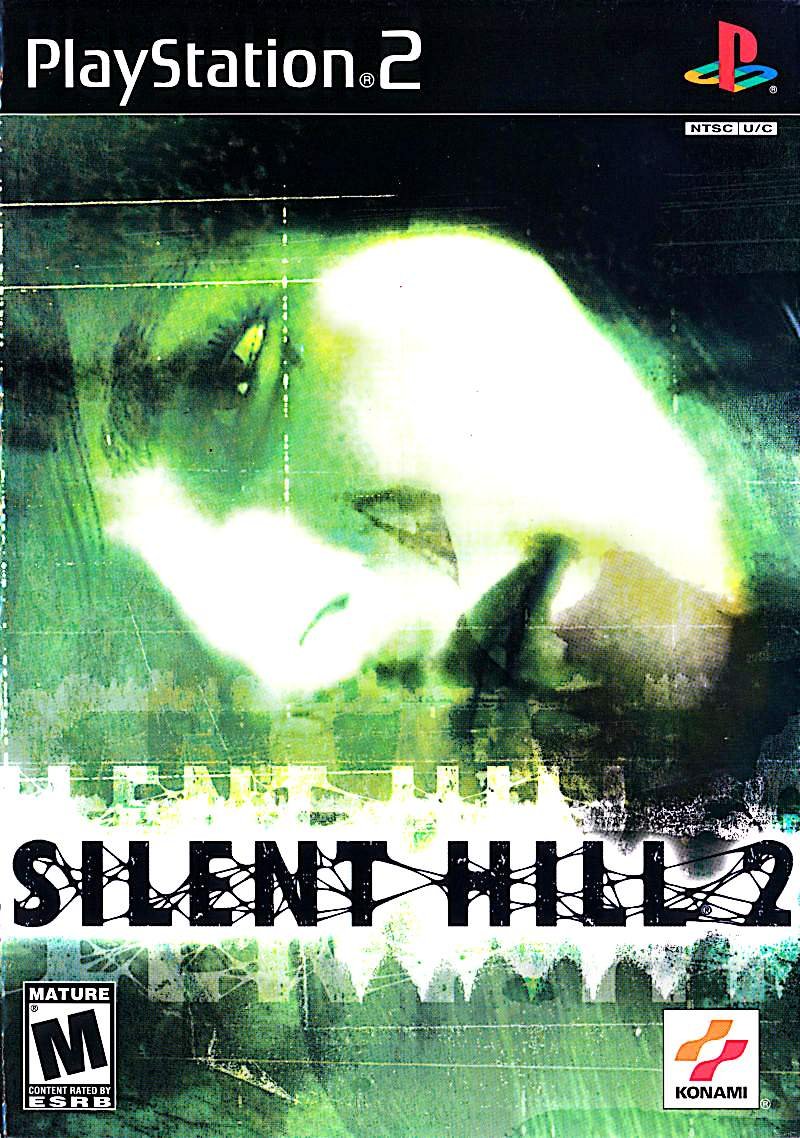
That opening explains much of the original game’s staying power. Released for the PlayStation 2 in 2001, Konami’s Silent Hill 2 understands how frightening it can be to continue doing something you cannot quite justify. Its best moments make the controller feel like an agreement you might regret signing.
There are monsters, puzzles and several opportunities to hit something with a plank. Yet the lasting disturbance comes from uncertainty about James, the people he meets and the place he has returned to. The game makes that uncertainty playable. You carry it down the street.
A town with room for your imagination
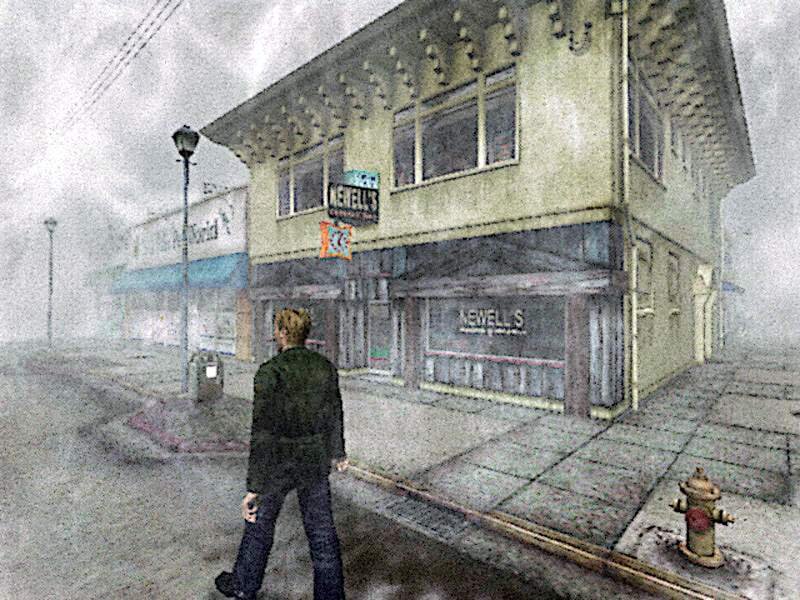
Silent Hill looks abandoned without looking conveniently arranged for an adventure. Streets stretch into fog. Apartments contain unlovely furniture. The hospital has the sort of institutional dullness that would be depressing even if its staff were behaving themselves. Familiar places have become difficult to trust.
The fog does more than hide an approaching creature. It restricts how much of the town you can understand at once. A road still exists beyond your view, but you cannot inspect it before committing to it. Buildings arrive gradually. A shape becomes a threat, a harmless object or something you would rather have spotted sooner.
There is a temptation to explain all this through old hardware: limited visibility, limited detail, limited everything. That misses how carefully the team used the stronger PS2. The sequel’s visual character was a choice as well as a technical achievement. More power did not require the town to become welcoming or completely legible.
In an August 2001 IGN interview, CG and character artist Takayoshi Sato described wanting a believable small American town, including accessible rooms with nothing in them. That modest detail is revealing. An empty room can disappoint a player expecting a reward. Here, it helps establish somewhere that seems to exist beyond your immediate needs.
You still search it, of course. Horror players are trained to inspect cupboards in buildings any sensible person would leave immediately. Silent Hill 2 exploits that habit. Opening a door does not guarantee a discovery, a fight or even a useful explanation. Sometimes you have simply entered another unpleasant room.
Those unproductive visits give the productive ones their weight. You cannot settle into a dependable rhythm of scare, recovery and prize. The town has time to get under your skin.
The noise you cannot place
Sound director and composer Akira Yamaoka gives that uncertainty another route into the room. The radio crackles near danger, supplying information without the comfort of a clear view. You know something is wrong. Knowing what to do about it remains your problem.
Other sounds are less helpful. A scrape, an industrial pulse or a distant impact can suggest activity somewhere outside the camera’s reach. You pause to listen. The noise persists, or stops before you have decided what it meant. Either way, your attention has moved from the thing you can see to the thing you are imagining.
Yamaoka’s work makes it difficult to separate music from the environment. Some passages sound like machinery that should have been switched off years ago. Others have a tenderness that feels almost indecent in such a place. The guitars of “Theme of Laura” and the quieter melancholy of “Promise (Reprise)” give the game an emotional range that a continuous stream of sinister drones could never provide.
In a 2002 interview with Spelmusik, Yamaoka described responsibility for the games’ entire sound, from effects and their timing to mixing. He also confirmed creating more than 200 footstep sounds for Silent Hill 2. The attention lavished on walking seems entirely appropriate. You spend so much of this game listening to a man move through places he should probably avoid.
Silence is just as useful. In the original making-of documentary, Yamaoka explained that selecting moments of silence was another way of producing sound. When the surrounding noise falls away, it does not necessarily feel like safety. It can make your own movement embarrassingly loud.
That is a wonderful, horrible trick. You start treating a normal action as a possible mistake. Standing still offers no solution, because eventually you have to open the door.
People who cannot quite reach one another
James has come looking for Mary, his wife, after receiving a letter that should be impossible. That premise supplies a mystery, but it also supplies a reason to distrust the journey before the game explains much of anything.
He meets other people who seem stranded inside their own troubles. Angela is guarded and distressed. Eddie moves between defensiveness and an unsettling appetite for grievance. Maria resembles Mary closely enough to make her presence immediately uncomfortable, while refusing to behave like a convenient replacement.
Their conversations rarely give you the clean handover of information expected from an adventure game. People hesitate. Replies arrive strangely. A question can sound reasonable and still feel completely inappropriate to the person receiving it. James does not always appear to understand the conversation any better than the player does.
The original performances can be uneven. Some lines land awkwardly, and affection for the game need not turn every questionable delivery into a secret masterstroke. Still, the overall effect is hard to dismiss. These people do not sound like a practiced ensemble guiding you efficiently through a plot. They sound disconnected, sometimes from one another and sometimes from themselves.
For me, the game’s most compelling quality is how difficult it makes easy sympathy. James is the character you control, so his search initially feels like your responsibility. That practical arrangement encourages emotional allegiance before you have enough information to know what it means.
The other characters complicate it. Their suffering does not neatly become evidence in James’s case. They have experiences he cannot fully access. Even when a conversation offers a clue, it can leave the uncomfortable feeling that he has heard only the part useful to him.
Sato told IGN that the team could build the sequel’s story before designing the game, and wanted its horror to coexist with emotionally moving scenes. That approach helps explain why the sadness never feels like a consolation prize handed out after the scares. It has been present in the spaces between them all along.
The body keeps getting in the way
James is a poor advert for decisive action. He turns, hesitates and swings with none of the reassuring grace of an action hero. A close encounter can become an undignified negotiation over position and distance. Getting around a creature is often more appealing than proving you can beat it.
There is useful vulnerability in that, although the combat is hardly beyond criticism. Repeated encounters can become routine. Once you understand an enemy, some of its menace evaporates. A camera angle that initially unsettles can later obscure something you simply need to see. The game sometimes annoys you in ways that add very little to its horror.
It also offers an alternative movement setting, so the claim that everyone must wrestle with tank controls to appreciate Silent Hill 2 is overstated. The discomfort comes from the whole arrangement: restricted sight, uncertain sounds, limited control of the view and a protagonist who never looks entirely at home in his body.
Maps provide a particularly good example of the game’s practical intelligence. James marks obstacles and discoveries as he explores. Gradually, a confusing building becomes a record of things you have tried. The map helps you progress without making the place emotionally easier to inhabit.
You can learn the layout and still dread the next corridor. Knowledge improves your route rather than your confidence in the world. Even an efficient trip back through familiar rooms can feel unpleasant, because you remember what happened there.
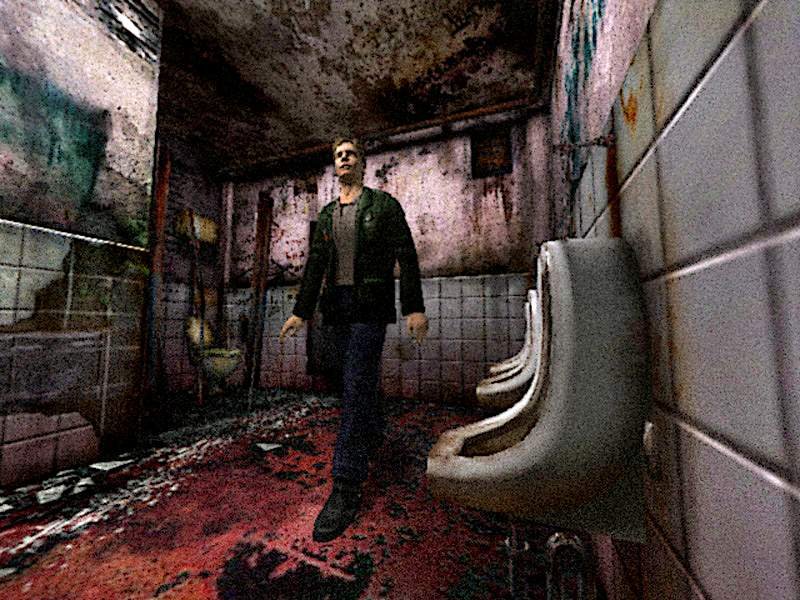
The original’s soft image and grain contribute to that feeling. A stain, a shadow and a patch of indistinct texture can be difficult to separate at a glance. The picture asks for interpretation. Its shortcomings sit beside deliberate effects so closely that they can become part of the experience, without requiring us to pretend every limitation was planned.
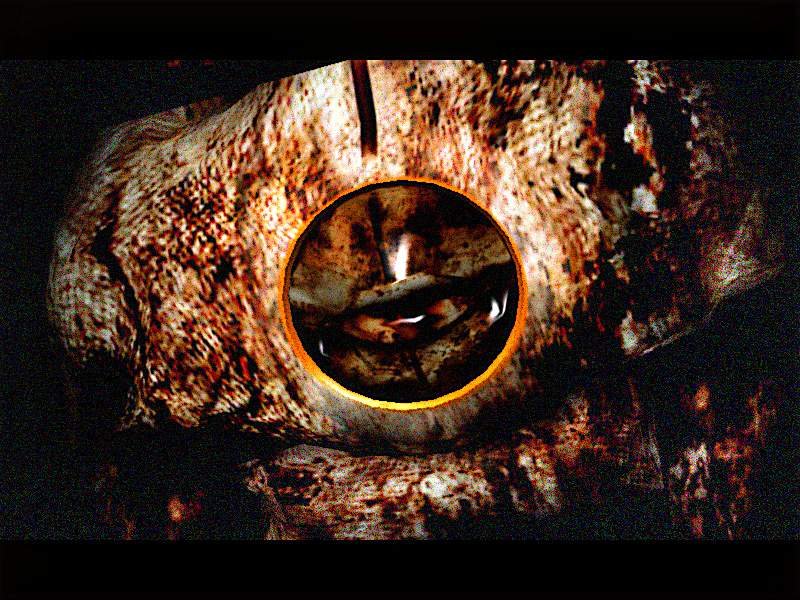
An obstructed view of James in Silent Hill 2 makes the room difficult to read. PS2 promotional image, 2001; Konami / Team Silent.
Monsters with an uncomfortable resemblance
Masahiro Ito’s creatures have enough of the human body left in them to make their distortions troubling. You recognize limbs, skin and gestures, then discover that those familiar parts have been arranged or animated in ways that refuse ordinary explanation.
In the making-of documentary, Ito described starting with human qualities and undermining them through strange movement and bodily angles. The effect is visible before any elaborate interpretation. A creature can seem injured, constrained or horribly incomplete, and still be coming towards you.
Pyramid Head is the most famous example, but fame has made him easy to misread as a portable symbol for anything scary. Within this game, his presence feels connected to James’s particular situation. His oppressive shape and movement make an impression before the story lets you understand that connection.
Trying to decode every enemy on first sight can flatten the encounter. It turns something disturbing into a worksheet with a correct answer. Silent Hill 2 is more effective when you allow recognition and revulsion to arrive before explanation. Meaning adds to the horror later; it need not supervise every second of it.
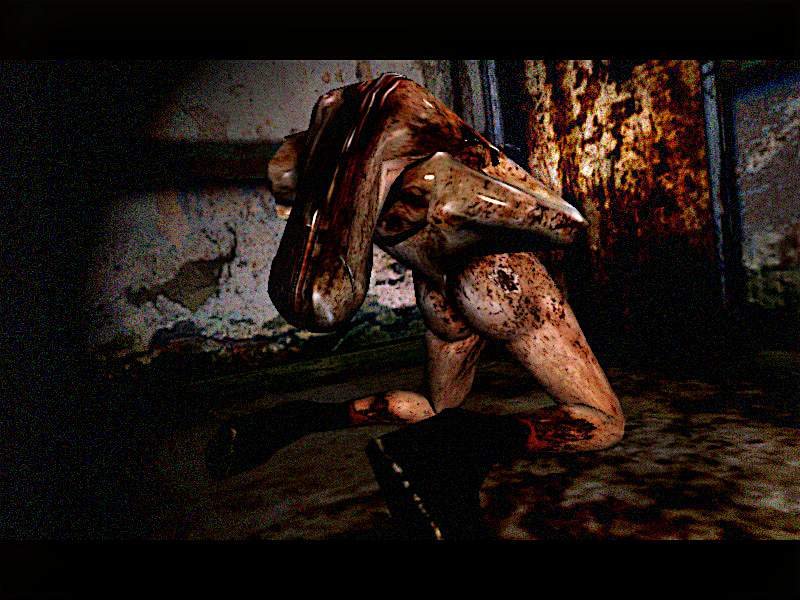
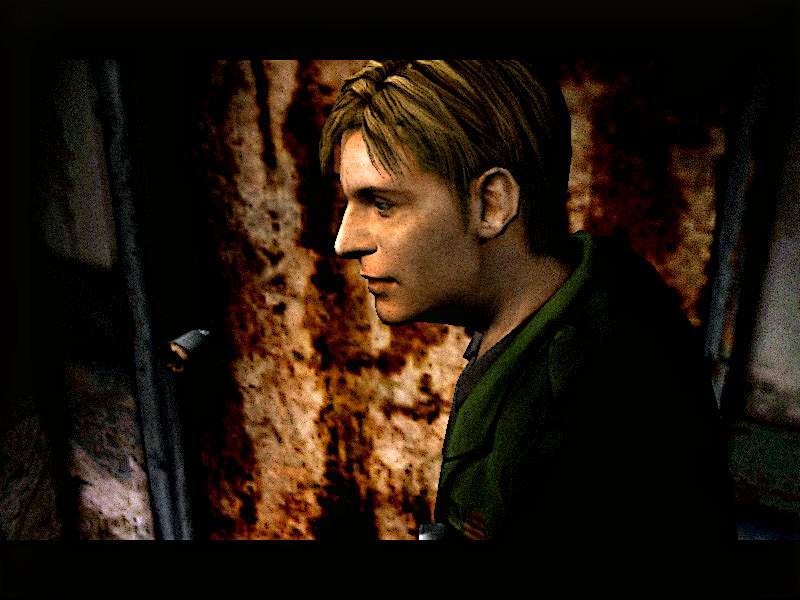
A distorted humanoid creature in Silent Hill 2. Familiar anatomy becomes unsettling. PS2 promotional image, 2001; Konami / Team Silent.
Why the original still gets under the skin
The game gives players plenty to discuss, but discussion can sometimes make it sound tidier than it feels. Themes get named. Images get translated. The ending becomes the destination of every earlier scene. On paper, the mystery can look like a mechanism you have successfully taken apart.
Playing through it restores the awkward stretches between those discoveries. You have to spend time with James before understanding him. You have to endure a conversation without knowing which detail will matter. You have to walk across another room when the soundtrack has made staying where you are seem equally unattractive.
That experience is why the original remains such a useful reference point for psychological horror. Its disturbing ideas emerge through the ordinary work of playing: looking, listening, navigating and deciding to continue. The player participates in James’s persistence long before being equipped to judge it.
There are rough edges worth acknowledging and passages that drag. Its reputation does not make every locked door fascinating. Yet its patience, strange performances and refusal to offer constant reassurance hold together remarkably well. The game leaves enough uncertainty for the player to supply something personal, then makes that contribution uncomfortable.
Years of explanation have not made the opening walk inviting. You know there is a town beyond the trees. You know you can reach it. Silent Hill 2 still gives you plenty of time to wish you had chosen another road.
David Becker (Retro Replay) is a writer with a passion for retro video games and gaming history. He enjoys digging into forgotten stories, exploring the people behind the games, and preserving what made them worth playing. Find his features, interviews, and gaming histories at Retro Replay.
Leave a Reply