

Most of us get pumped when we see a beloved franchise make an unexpected comeback. I know that’s how I reacted to the Final Fantasy Resonance reveal back in June.
I only played the original Final Fantasy Brave Exvius (FFBE) for a short time, but I was waaaayyyy deep into War of the Visions (WOTV) — the tactical turn-based spin-off. I spent my share of time with Rain, Lasswell, and Fina, and honestly, I did feel a pinch of sadness when WOTV shut down. The sudden prospect of reuniting with the Brave Exvius IP all these years later made Resonance a must-play for me as soon as it was announced.
But gut reactions are a funny thing. After a while, my rational self took back control, and I was left with some questions that I think most series fans were asking themselves too. Namely, how would Square Enix adapt a gacha game into a standalone title? How would they deal with the broken-up narrative, made-for-mobile gameplay, and the thousands of visions across both games?
We have some definitive answers now that the demo is out on Steam, and sadly, I have some mixed feelings about them. Resonance is a good adaptation of the original FFBE, but the way it uses features from other Final Fantasy games feels recycled and slapped together.
Resonance Is Brave Exivus With Some Tweaks
For starters, the story showcased in the demo is very similar to the original game. Rain and Lasswell are sent on a mission by the king of Granshelt to investigate some strange occurrences at the Earth Crystal Shrine. There, they encounter Golbe…err…I mean Garlan…shit…I mean the Veritas of Dark, who promptly kicks both their asses and shatters the crystal for good measure.
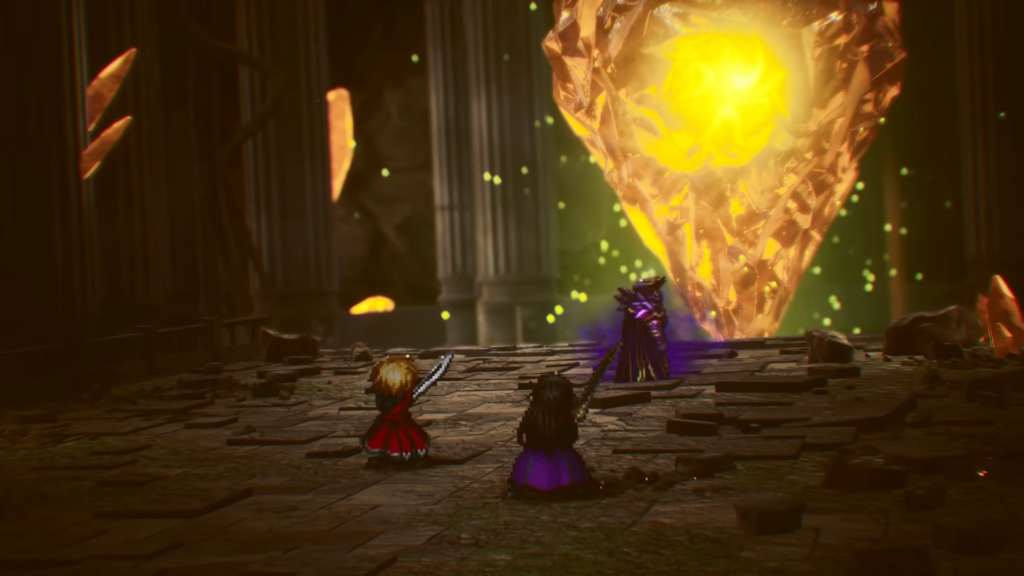
That kicks of a buddy adventure with Fina in tow to hunt down the six Veritas and prevent them from destroying all eight crystals that power the world of Lapis.
The story can’t identical, obviously, because the mobile game was a live-service broken down into discrete missions. Square Enix had to rework the narrative to support an open world romp.
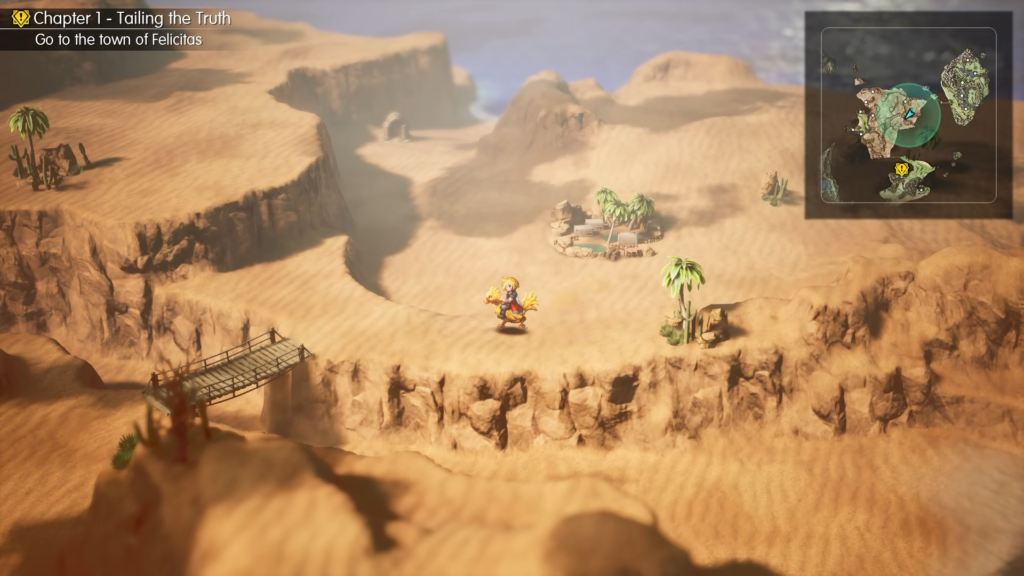
Speaking of which, I’ve seen a lot of positive comments in early coverage about the new world map. It’s true that this is a great addition for mobile players who were limited to mission content. But I can’t stop reminding myself that every single Final Fantasy title prior to FF12 had an open global map. So really, Resonance only brings FFBE up to par with the rest of the series.
What did stand out to me was the voice acting, because FFBE mainly relied on text-based dialogue, while WOTV only included spoken lines for main quests. And while it’s possible to get a sense for a character’s personality from only text, there’s nothing like a voice performance to convey a character’s emotional depth.
And you know what, maybe reworking a 10-year-old story with updated graphics, 40 new side quests, some voice acting, and an overworld map is enough to bring back FFBE fans! I was absolutely ready to buy in based on the annoucement alone. That is, until I realized just how similar Resonance was to Final Fantasy 4 after experiencing it as a continuous narrative.
No? Well, Cecil and Rain are both airship squadron commanders. They both set off on a kingly quest with their respective childhood friends Kain and Lasswell. They both lose their commands at the very start of the game. A mysterious female summoner joins both of their parties early on. Their worlds are both powered by kingdom-owned crystals that are coveted by black-armor-clad tyrants.
The sad truth is that FFBE was written to keep us spending money on gacha banners for 10 years, not to be a great single-player entry in one of the greatest JRPG series of all time. That really came across in the demo.
The Gameplay is Mostly Recycled
And it wasn’t just a problem with the story. The gameplay also seemed plucked from different titles to plug holes left by the transition away from mobile.
Encounters are the same old thing. They start after you walk around the map for a bit. There’s now an indicator on the mini-map that turns red when a fight is close. That’s a nice touch, but it doesn’t change much.
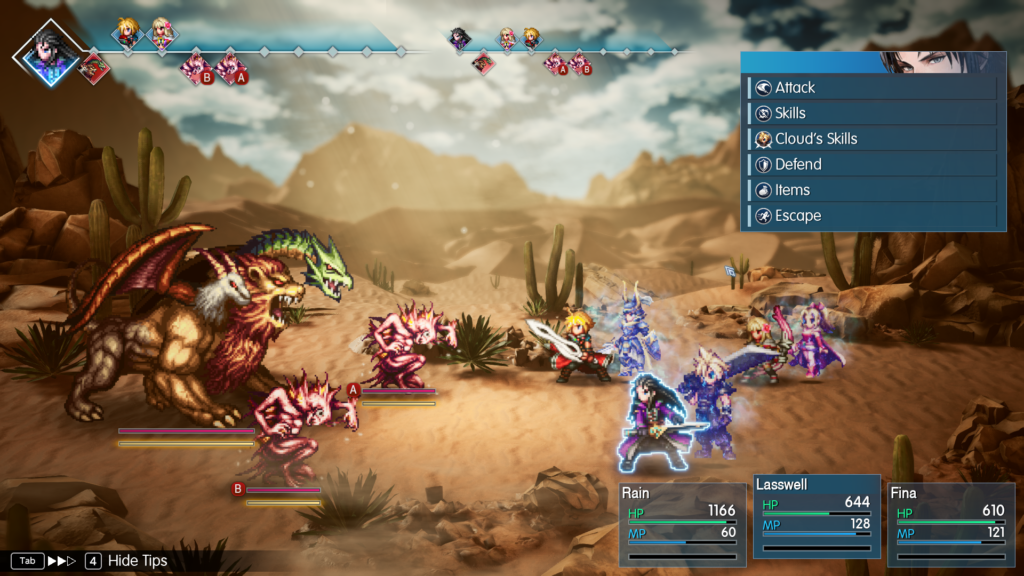
Combat unfolds exactly like a classic JRPG where units attack each other in turn. Resonance only starts you off with a “skills” menu that lists a bunch of abilities that unlock at set levels. This is basic Dragon Warrior stuff. Sure, that’s a legendary game in its own right, but the mechanics feel very dated in a 2D-HD title 37 years later. Even Limit Bursts, which were introduced in the OG version of Final Fantasy 7, are reaching the end of their shelf life. And someone tell me why half the enemy models are pulled straight from Final Fantasy 6?
FFBE’s combat loop was much more interactive than this. You had to tap on your party members to chain their attacks together and dish out big combos. That’s essentially the same format as Valkyrie Profile — another one of my favorite Square Enix licenses. The studio could’ve used that as a blueprint to come up with something far more exciting that we haven’t seen in a mainline Final Fantasy.
Instead, Resonance tried to differentiate its combat with FFBE’s stagger feature.
In this version, each enemy has a break bar. Depleting it with attacks stuns them for one turn and drastically increases the damage they take. Attacking an enemy with an element they’re weak against massively increases break damage, and the character who applies the stagger gets a bonus attack at the end of the round. Staggering every enemy in the same round triggers a sweep that gives your whole party a bonus attack and allows one of them to fire their assigned vision’s limit burst.
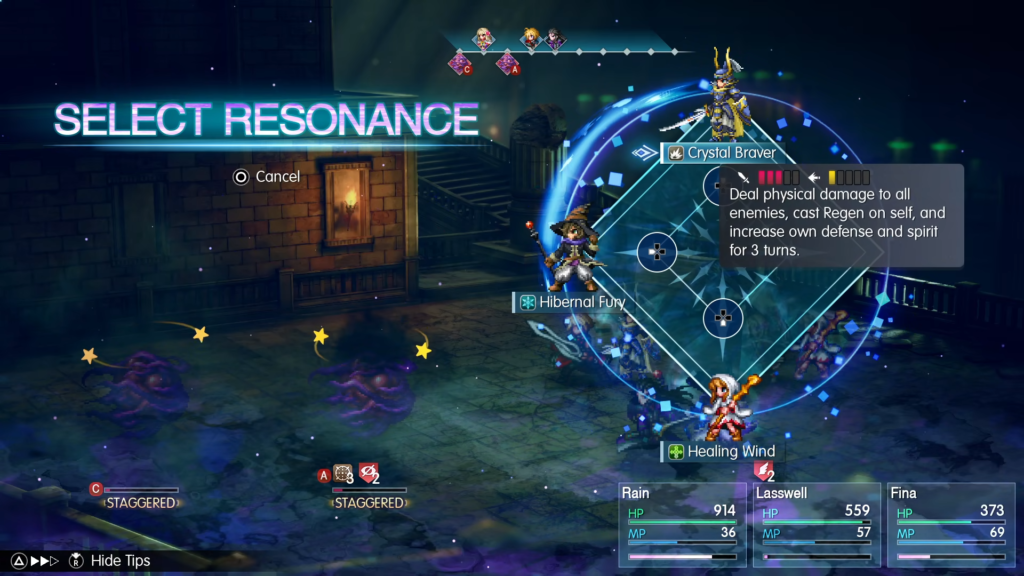
It’s basically the same set up as Persona 5! And while it does provide some much-needed tactical play, it quickly devolves into spamming the same moves that target elemental weaknesses.
I can get behind the idea that the devs were going for an old-school feel, but I think they overshot whatever that was supposed to be. As a deep Final Fantasy fan, I still have an expectation that each title innovates somehow. Final Fantasy 3 introduced the job system, Final Fantasy 4 rolled out active battles, and Final Fantasy 6 put customization in the player’s hands with magicite. Resonance borrows from these ideas, but it doesn’t really expand on them in any significant way.
Visions Can’t Replace the Job System
Oh, and what about the visions!? They were the main attraction in both Brave Exivus mobile titles. There were well over a hundred of them in WOTV and just under two thousand in FFBE. Each one of them was a playable character that you could upgrade, evolve and control in battle. So what happened to all of them?
Essentially, Square Enix repurposed visions into a Final Fantasy Tactics-style job system. Instead of building them up as characters, you equip them to grant one of your warriors a fixed set of skills. As that character collects MR points — Resonance’s equivalent to job points — their affinity with the vision grows, they receive permanent upgrades to their stats, and gain access to special passive abilities.
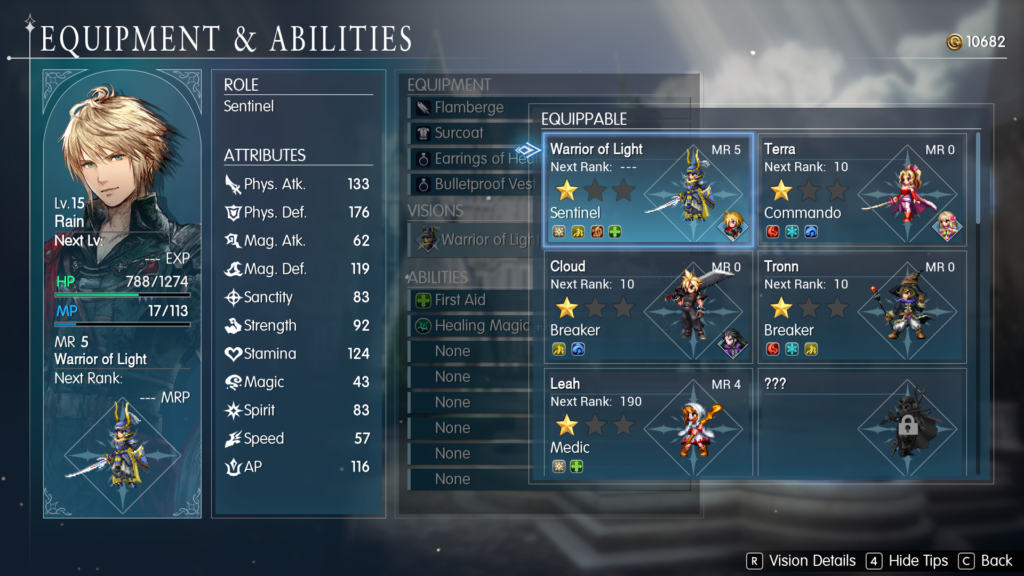
The vision feature is probably the most original thing about Resonance, but it’s not nearly as satisfying as the mobile version’s. There was something special about hitting a rare unit on a banner, building them up with resources you had to grind for, and using them in battle. Now, you find them in shrines spread out on the map, and equipping one mostly amounts to adding a new “skills” menu. There’s no challenge involved either; you just answer a three-question quiz to reminisce about the vision’s personality and they’re yours to keep.
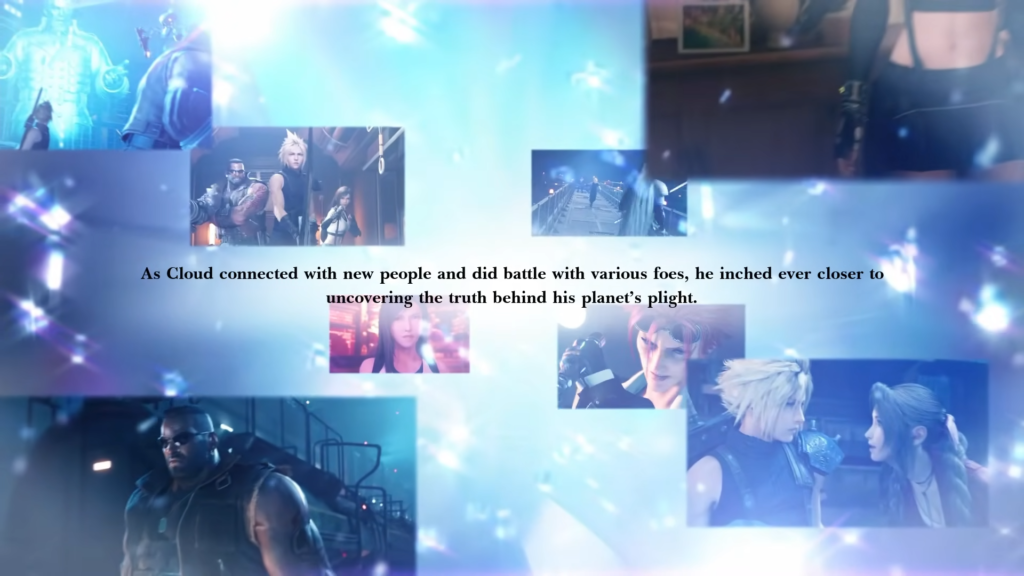
I was equally disappointed to learn that there will only be 26 total visions in the game. I’m sure Square Enix will focus on the most recognizable ones to satisfy people like me who have been loyal to the franchise since its NES days. The demo featured Cloud, the Warrior of Light, and Terra, and you’ll also collect household names like Sephiroth, Noctis, and Squall in the full game.
I’ll admit that some of them pull at my fandom heartstrings, but I can’t help but feel like we’re getting a watered-down version of both FFBE and the job system that Square Enix has cultivated over literally decades.
I’m Not So Sure Anymore
And that’s how I went from super excited about Resonance to skeptical about paying full price just from playing the demo.
My main take away is this: don’t dive into Resonance expecting something new and exciting. Even if you’re completely new to FFBE and you’re experiencing the story for the first time, there are aspects of it that might fall short of your expectations — especially if you’re coming from other modern 2D-HD games like Octopath Traveler 0 or The Adventures of Elliot.
I wouldn’t treat this as a full Final Fantasy entry. My impression after the demo is that this a remix of an 10-year old IP, reimagined as Final Fantasy 4 with a few extras bolted onto it.
I love classic Final Fantasy, and I committed a lot of time and money to the Brave Exvius franchise, but do I really want to pay full price for a game that doesn’t build on either? That’s why I don’t think I’m going to play Resonance right away, and if I do, it’ll probably be purely for nostalgia’s sake.
Leave a Reply