

I was looking forward to playing Belmont’s Curse more than any other game this year, and my expectations were firmly set on a modern Symphony of the Night. Did the Evil Empire and Motion Twin manage to live up to this most venerable of games?
Kind of…
After playing through the game, I can tell that they tried, but certain things got lost in translation. It’s almost as though the developers attempted to respect the original IP while trying to bring it up to date with modern Metroidvanias without totally abandoning their Dead Cells pedigree.
The result is something that looks familiar, but plays very differently from previous entries in the line of 2D Castlevania games. Some of these choices worked for me despite departing from SotN, but others felt out of place, and not in a good way.
Too Many Conflicting Ideas
After thinking about why that was for a few days, I concluded that there were just too many influences on the game’s design. You could compare Belmont’s Curse to SotN, Super Castlevania, or even Hollow Knight, and be right in some way.
But it’s how these ideas play out in the Castlevania context that’s the real problem.
For example, Dead Cells is first and foremost a roguelike game, and it’s well understood in that genre that you have to start over from the beginning when you die. That’s why Dead Cells’ levels tend to be linear with hubs at each end to power-up in between.
Well, in Belmont’s Curse, that design philosophy translated into very few save points in any given area to challenge the player with progressively longer and more difficult “runs” like those you might encounter in a roguelike. Each save point then gets you ready for the next leg, but without the power-up. That doesn’t work in a harder Metroidvania like Belmont’s Curse. I died often, and it sucked to repeat long stretches of content I just cleared.
Braving these sections often led to rewards that weren’t worth it at all. The developers tried to implement an SotN-lite equipment system with a mix of relics and collectible weapons, but they didn’t spread them out very well. I found most of the legendary weapons well before the lower-rarity ones, and I mostly stuck to the same five or six relics out of the 44 available.

On a positive note, I loved Rose’s ability to swing around using a magical whip. It screamed Super Castlevania — one of my favorite SNES games. The trade-off, however, was that relying on the whip delayed Rose’s access to other important traversal abilities. I mean, what’s the point of the whip if you can already double-jump and air dash? That’s why I found her a little sluggish compared to Hornet from Silksong or Kashi from Fatal Claw.

And that leads me to perhaps the strangest design choice of all…
Combat is the Biggest Source of Frustration
I’m talking, of course, about the skill-based combat that involves timed blocks and slides to avoid getting pulverized by the game’s many foes.
First off, Soulsvanias, if you’ll forgive the expression, aren’t for everyone. It’s true that games like Blasphemous, Hollow Knight, and Ender Lilies have had their share of success despite their steep challenge curves, but they’ve also turned away a large share of casual players.
Personally, I’ve only found timing-based combat enjoyable in certain conditions, the most important of which is managing the number of attacks a player has to to deal with at once — something Belmont’s Curse doesn’t always respect.

Unfortunately, Rose couldn’t reliably jump over enemies for the first half of the game or slide worth a damn, and that created a lot of early encounters where I simply couldn’t avoid damage if I was fighting two or more enemies at once. That, in turn, meant a lot of dying in between the game’s distant save points.
To be fair, the combat system worked great for one-on-one boss fights that usually leveraged the whip ability to make up for Rose’s terrible vertical mobility. These encounters were well-designed and fun because they relied more on positioning than perfect blocking — which is more in line with how Castlevania games usually roll.

Beating a boss unlocked their Tarot card, Belmont’s Curse’s equivalent to spell abilities. The system itself was cool, especially how you could upgrade the cards by completing feats. But once again, I found the spells themselves underwhelming because their high MP costs limited how often I could use them, while their lengthy casting times made the spells difficult to pull off without taking damage in the process.
Combat was one of the main reasons Belmont’s Curse felt “off” to me at times. The developers tried to incorporate a style of fighting that’s “in vogue” at the moment, but it clashed with Castlevania’s identity.
Looks the Part
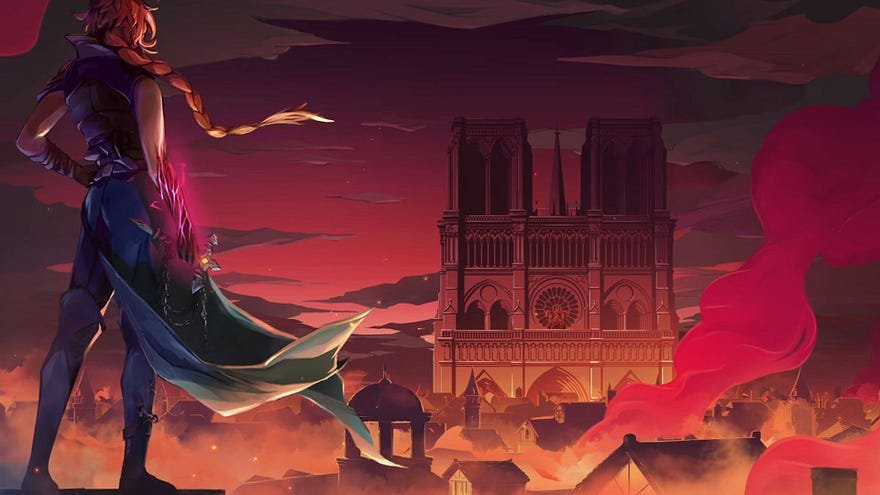
It’s a good thing, then, that Evil Empire and Motion Twin nailed the presentation. I’d even go as far as to say that any resemblance to Symphony of the Night is because of how Belmont’s Curse looks.
All the locales I expected to see in a devastated Paris were there and wonderfully re-imagined with an aesthetic clearly inspired by Dead Cells. Dracula’s Castle looks as foreboding as ever. All the recognizable enemies, like Sahaguins, Medusa Heads, and Phantom Armors, look amazing.

The soundtrack brought it all home for me with its menacing, high-tempo organ pieces. It was the perfect mood-setter for an epic quest to kill the Lord of Evil.
I was worried that the level design might mimic Dead Cells’ mostly horizontal flow, but that wasn’t the case at all. Belmont’s Curse is a true Metroidvania, with maze-like maps and tons of secrets to discover.

The writing was the only real disappointment for me. Rose came across as an impetuous teen who constantly refused everyone’s advice. I spent most of the game being annoyed with her, and I didn’t buy her sudden turnaround at the end.
That small blemish aside, Belmont’s Curse scratched my proverbial itch for more Castlevania with its incredible visuals and atmosphere. In more ways than one too, because it also delivered on another critical Metroidvania feature.
Platforming Sets Belmont’s Curse Apart
Like combat, the platforming in Belmont’s Curse breaks away from traditional Castlevania towards a more contemporary approach.
Seriously, Belmont’s Curse reminded me of Silksong with its crazy array of traps. You know, the ones that make you wonder why an architect would ever put moving buzzsaws in between collapsing platforms over a pit of spikes in the hallway from the main entrance to the dining room.

I thought most of these parkour sections were well implemented, and Rose’s whip ability was a great touch to make them more complex and interesting. Rose’s Holy Light ability, which let her phase through certain blocks, also added a new dimension I hadn’t experienced before.

I really enjoy these types of challenges in 2D games, and they work in Belmont’s Curse because they’re built around Rose’s movements in a way that makes her feel way more agile than when she’s fighting. In fact, that contrast between the platforming and combat reinforced my sense that the latter doesn’t really fit, and could’ve been handled differently.
I also understand how frustrating the parkour elements in Belmont’s Curse can be. They raise the difficulty level way beyond the comparatively simple platform hopping in SotN, to the point where it feels like a very different game.
Verdict
Ultimately, Belmont’s Curse is best suited for genre veterans who crave challenging titles and can appreciate the ideas that Evil Empire and Motion Twin tried to embed into a well-established franchise. I increasingly consider myself part of that crowd, and I had a good overall experience with it despite some of the issues I raised.
It’s franchise fans hoping for a modern successor to Symphony of the Night who will struggle with Belmont’s Curse. It looks the part, but it’s much harder and plays very differently.
If that’s you, I would recommend waiting for the price to come down a bit or getting some hands-on time with the game at a friend’s house before you make a decision.
Woody recommends it
- 25 hours in
- PC
- Bought it
Leave a Reply