
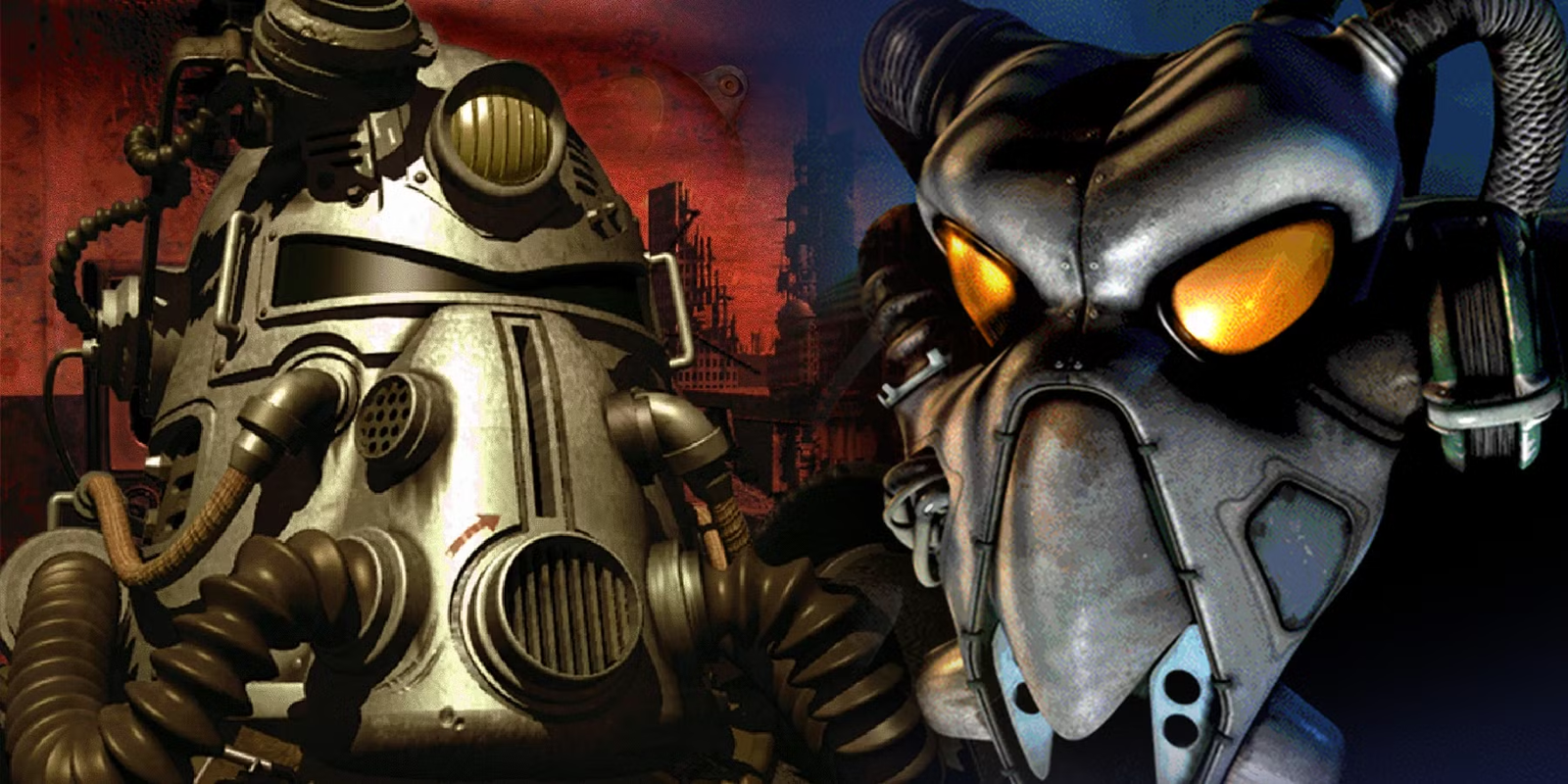

I don’t think any warning could have prepared me for how much Fallout 1 ruined my experience with both Fallout New Vegas and 3. It was genuinely saddening to dive into such an interesting looking universe, just to realize it hadn’t had any real work done since 1998.
To ensure I wasn’t about to be blinded by retro PC nostalgia, I approached the franchise deliberately, dividing my playthroughs to keep my perspective unbiased. I started with Fallout 3, jumped back to Fallout 1, moved on to New Vegas, and finally capped it off with Fallout 2. I wanted to experience the evolution of the wasteland firsthand, but received some brutal realizations.
Let’s be clear first of all, the jump to 3D brought undeniable gameplay upgrades to the franchise and gorgeous environments. Roaming DC and the Mojave with their iconic radios is an atmospheric joyride like no other for open world games, and the moment to moment gameplay is objectively smoother. Unfortunately, it felt like the teams responsible forgot to put some elbow grease onto the universe.
Booting up Fallout 1 felt like unmasking an illusion. The 1997 original is a masterpiece in writing, tight pacing, and self containment. Most importantly though, it holds almost every single strand of the franchise’s DNA. Picture my surprise when I found a Mr.Handy in the game! A companion no less! Playing it completely ruined Fallout 3’s plot, which suddenly felt like fan fiction more than a growing universe. A repackaging of the isometric games, but with less nuance, and way lower stakes.
Fallout 1 and 2 felt transcendental. They didn’t just introduce factions with obvious personalities and square objectives for you to just shoot at; they actually explored the birth, philosophy and evolution of entire societies. You unironically felt the weight of shaping communities, continents and even the entire world.
By contrast, jumping back into the 3D era with New Vegas (which was an amazing title that somehow exceeded expectations) felt weirdly claustrophobic. I found myself settling localized border disputes and minor conflicts with struggling allies and enemies. This leap to 3D was supposed to make the universe limitless, but it somehow wasn’t the case.
Recycling the Apocalypse
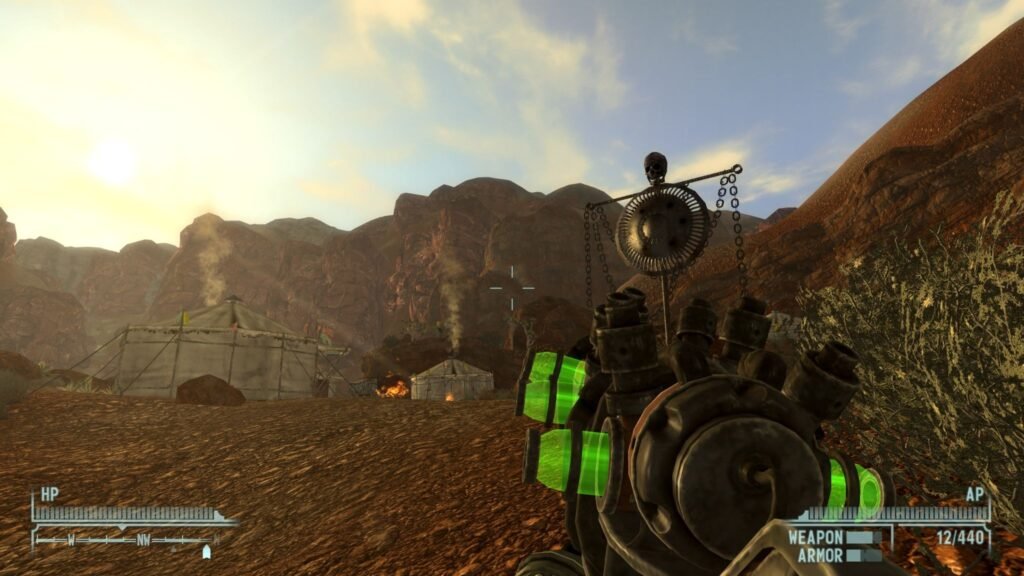
If you were lucky enough to play Fallout 3 in a vacuum, stepping out of 101 and seeing the desolate wasteland is a breathtaking moment. If you were a poor soul who had played Fallout 1 first you suddenly discover you are just visiting a museum of 1997’s best ideas, inexplicably transported about 5000 kilometres to the East Coast.
It’s disheartening to see. The original games built brand new factions as organic responses to society, the wasteland and the breakout of the war. The Super Mutants were the tragic army of The Master. The Brotherhood of Steel were a reclusive community shaped by their founder’s first-hand disillusionment with the government. They made sense in their geographical and narrative context.
But somehow the modern titles seemed terrified of their own shadow in a way. Instead of asking “What unique societies would naturally evolve in the irradiated ruins of Washington D.C.?” they must have asked themselves “How can we justify dragging the BoS and Mutants across the entire country?” thus resulting in what I believe is a universe that feels artificially small.
This thought came to me immediately after finishing Fallout 1, and as upset as I felt, the shock was even greater when I experienced Fallout 2. The sequel didn’t just paste The Master into a new map. It moved the timeline, it let old threats die, and it shrank the BoS into a trivial force to allow the spotlight a new subject. You saw the NCR establish laws and infrastructure, towns minting their own currencies, and societies like Vault City clearly moving past the apocalypse.
Now as much as I adore New Vegas it isn’t entirely immune to the scaling issue. Obsidian did some insane heavy lifting of carrying the West Coast lore forward, but the scope of a 3D engine fundamentally changes stakes and scopes. It is a well written regional concept, but I just wish it wasn’t that much regional.
Forgetting the Fallout: Rebuilding Humans and Sins
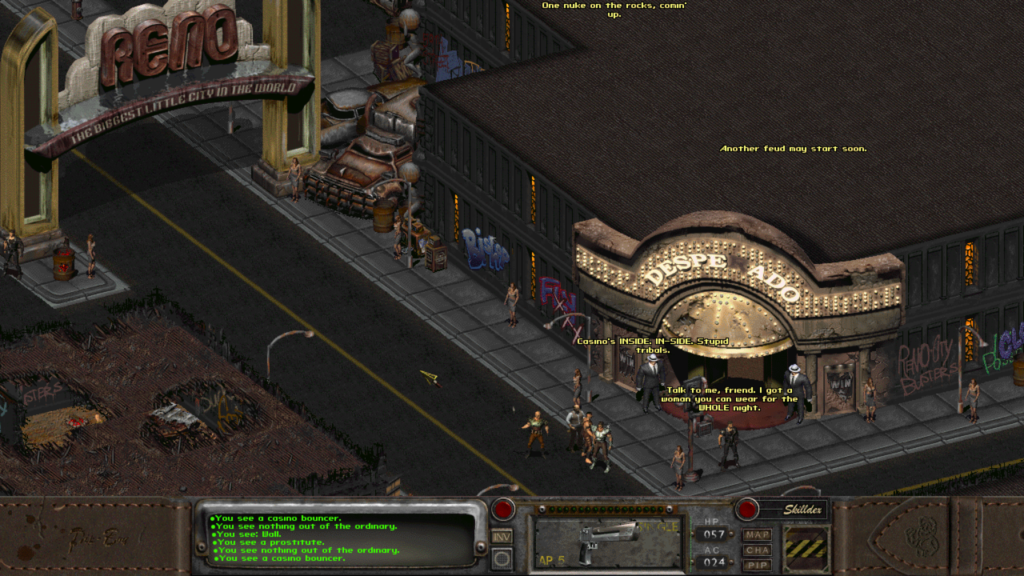
Onto more positive thoughts now, we gotta talk about how amazingly portrayed New Reno is.
If the modern games are a window into obsessing over the apocalypse while drowning in old world blues, Fallout 2 is a masterclass in what happens to society when surviving and scavenging is no longer the primary objective. And that narrative game is specifically portrayed in the gorgeous New Reno.
Stepping, or better yet, parking in New Reno creates the most jarring narrative gap with this concept of fixating with the radiation and Fancy Lads Snack Cakes. The city serves up all of humanity’s deepest instincts and depravities on a silver tray. Fully functioning, ‘thriving’ metropolis (yes, I’ll leave it at that) built entirely on sin and vice. No more fighting mutated bugs in the aisles of a grocery store, you navigate the vicious politics of organized crime families while untangling mass production of addictive drugs, stumble upon underground boxing rings and even willingly wander into the set of a porn studio.
That is the brilliance of Fallout 2 that was pretty much lost over the years. The developers understood one very important thing. Humanity’s greatest threat after world changing events wouldn’t be permanently irradiated cockroaches. Eventually humanity would rebuild, and the very first things we would rebuild are our sins.
It’s no exaggeration to say that New Reno makes the apocalypse a distant memory. It’s a very neat realization that human nature survived the blast completely intact. That systematic, hierarchical and capitalistic feeling of human failure is never lost in any corner you might venture in.
Nothing is a coincidence. New Vegas finally ‘clicked’ for me when I reached Freeside, and it is just not a coincidence. Freeside and the Strip are the spiritual, if not literal, successors to New Reno’s neon-lit anarchy. It made even more sense when I investigated the teams at Black Isle and peeped how the same minds that crafted the Mordinos and the Wrights eventually built the Omertas and the Kings. They carried forward that same thesis. They aren’t asking how we survive the apocalypse, they’re asking what we become once we’ve survived it. And the answer, tragically, is exactly what we were before the bombs fell.
Engines of the Old World
To wrap this up, we have to look at how societal evolution translates to technology and stakes. When people think of Fallout these days the immediate image is scrap pipe rifles or endlessly walking through ruins filled with glue bottles and dusty fans. But playing the classic games is a huge reality check, a clear and expected move past the stone age.
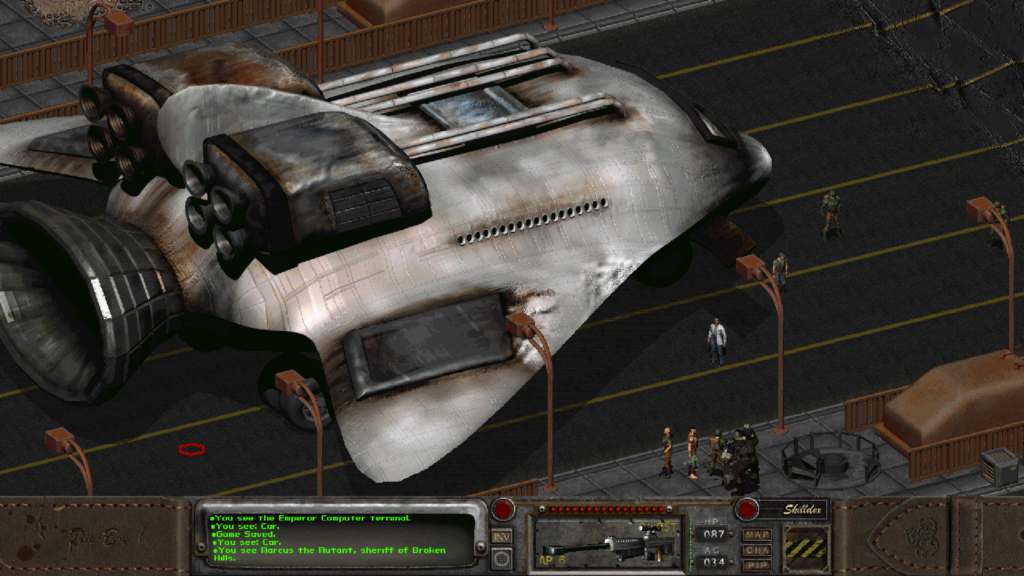
By the time you reach the mid game of Fallout 2 there’s little to no scavenging. You are uncovering pristine military bunkers, repairing a Chryslus Highwayman to literally drive across the vast stretches of the desert. You are consuming energy cells and navigating a world filled with supply lines, contracts and infrastructure. You eventually commandeer the PMV Valdez, a fully functioning oil tanker, to navigate the ocean and reach a fortified offshore oil rig. The scale is just not comparable, it makes the 3D map markers feel like a neighborhood sandbox.
The inclusion of cars, boats and high-tech facilities isn’t just for cool set pieces, they tie into a very serious geopolitical plot. When you finally reach that Enclave oil rig, you realize you aren’t fighting some scrappy junkies or starving raiders. You are facing a remnant of the United States government in all its glory, that manufactures Vertibirds, produces advanced Power Armor and plots global annihilation. They represent that industrial systemic power that truly feels threatening, not just the very repetitive local thuggery.
The classic games truly understood that a post-apocalyptic story eventually has to stop being about the apocalypse, and you can find this in other examples such as The Walking Dead, The Last of Us and even Dying Light. The immediate threat of monsters gradually becomes background noise to the larger complexity of human nature.
Fallout 2 distances itself from that primal daily struggle so much that they even laugh about the premise of its predecessor. In a very funny easter egg, you can find a storage room in Vault City where a couple of hundreds Water Chips pile up in boxes gathering dust. That same device that kickstarted the very desperate and tragic plot of Fallout 1. And funnily enough, that joke seems to hit even harder years later, after Bethesda builds an entire game around the struggle for a giant water purifier.
Leaving the Big Empty
I know this critique might sound harsh, but sometimes you gotta cruelly dissect something to extract some decent thoughts and realizations. None of this means I regret any of the 200 hours I spent in both 3D games, nor do I hold any sort of gatekeeping feeling.
I just wish a universe that has existed for this long got the narrative progression it deserves. And that means no more strains of the FEV virus magically appearing and no more BoS flying with blimps to suddenly interject in random parts of the USA to fill a quota for brand recognition. Cheap static factions and cities shouldn’t be the standard anymore.
And because of that, I only ask for the wasteland to actually evolve.
Leave a Reply