
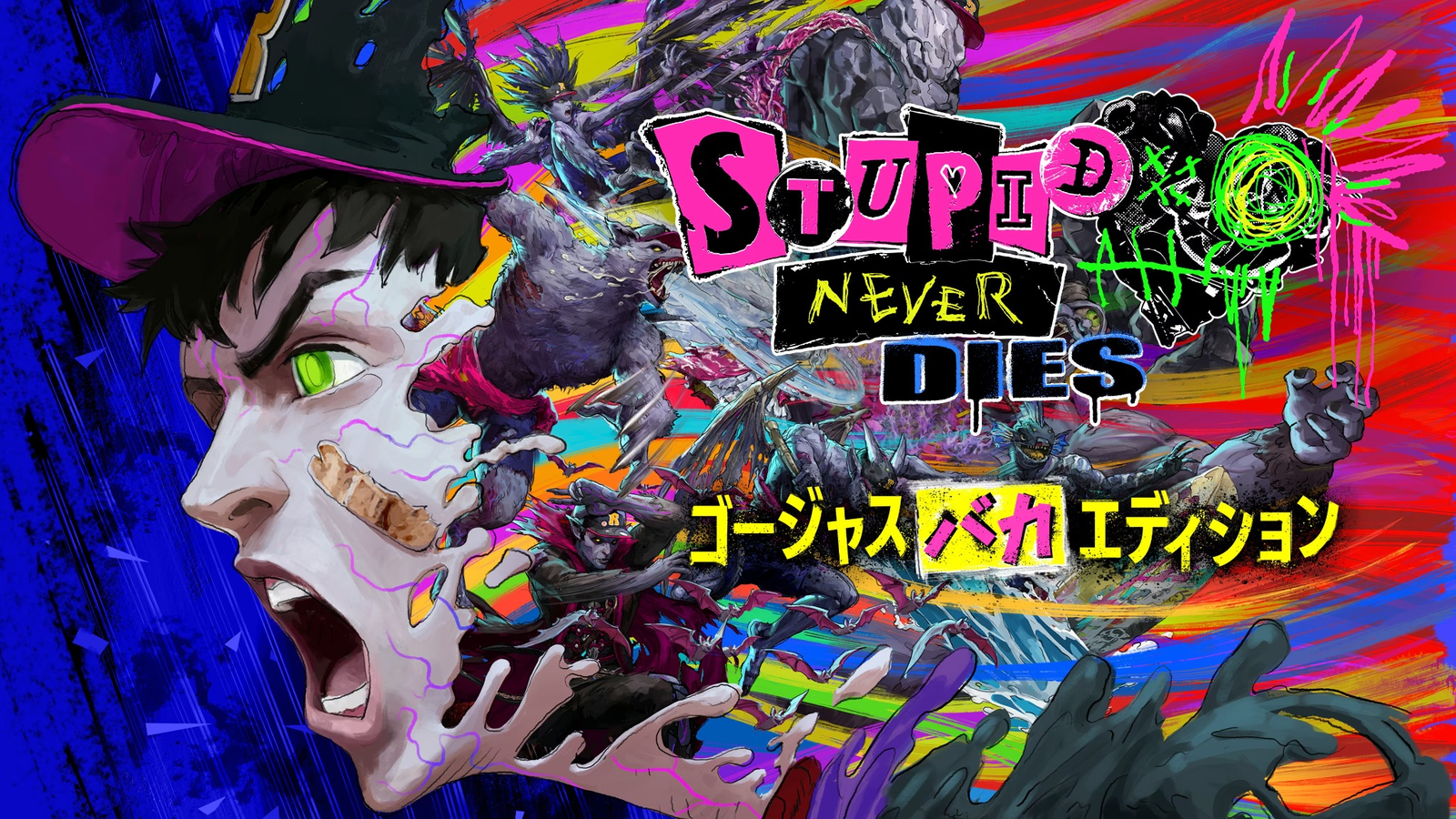

Stupid Never Dies is a linear, rogue-lite dungeon crawler that, while mechanically familiar to anyone experienced with the genre, distinguishes itself through fresh “Style” combat mechanics, extensive build customisation, and an unapologetically bombastic presentation style!
Story & Presentation: Unapologetic B-Movie Charm
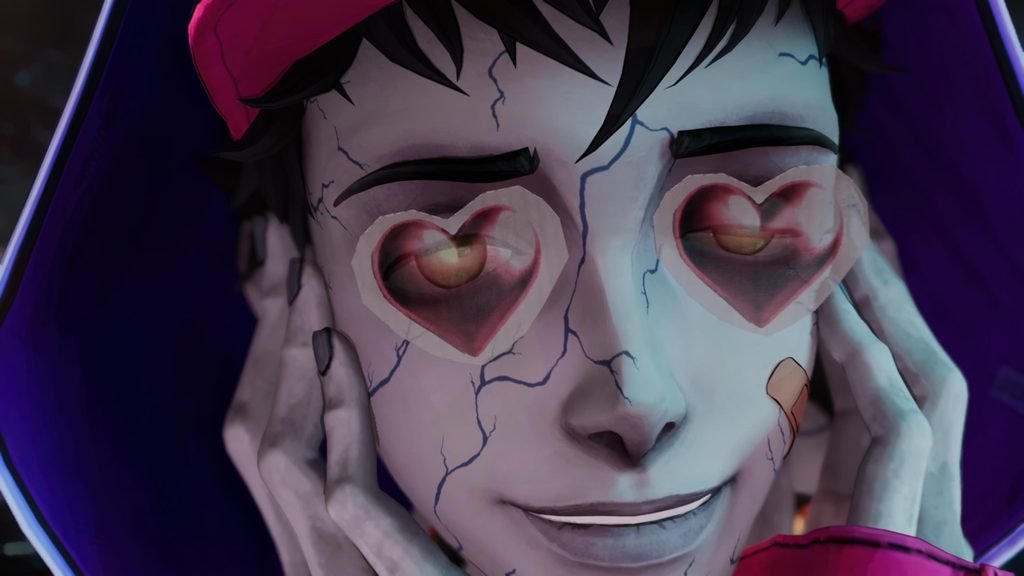
Stupid Never Dies does not take itself seriously at all, and that is easily one of its greatest strengths. Positively brimming with charisma, it features an eye-catching scrapbook aesthetic paired with vibrant, cell-shaded anime graphics that really pop on screen. The character designs are bold and memorable (such as Dr. Frank with his metallic cyborg frame, and Davy with his pale, veiny, bandaid-plastered face), fitting seamlessly into the game’s unserious, comedic tone.
From its engaging rom-com opening evoking Warm Bodies, to bombastic combat reminiscent of Lollipop Chainsaw, to wacky characters and world-building akin to Psychonauts and the progression loop and eccentricity of Let It Die—Stupid Never Dies never loses sight of its ridiculous personality.
Set in a trippy alternate Earth overrun by zombies, monsters, and fantastical creatures, the narrative is suitably silly. It delivers wacky rom-com vibes from the jump: Davy, a zombie outcast who refused to fight in the zombie war, falls head over heels for a human girl named Julia. The twist? She’s cryogenically frozen in a shopping mall freezer! Davy has never spoken to her, and she has no idea he exists. To make matters stranger, meeting Julia inspired Davy to stop eating humans altogether.
This gives Davy an affable, surprisingly relatable characterisation and motivation: grow stronger by running dungeons to defeat the evil King of Monsters (KOM) and save his frozen crush. The narrative is further bolstered by a charming side-progression system where you unlock fragments of Julia’s past by recovering her phone and reading her old social media posts.
Supporting Davy is an absurd cast of side characters—a talking gargoyle, a cyborg scientist, an assistant doctor wearing an oversized trench coat, and a motorcycle-riding fellow zombie running a burger stall. Their banter, humorous dialogue, and trippy cutscenes prop up the game’s intense charm. As someone who grew up on classic early-2000s raunchy teen and spoof comedies like American Pie and Scary Movie, this style of slapstick, cartoonish humor landed perfectly for me.
The Pacing Friction
My primary critique regarding presentation is how exposition-heavy this demo can be. I am notoriously impatient with extended tutorials; I learn best by doing and struggle to retain large walls of text without immediate gameplay engagement.
There is a noticeable lull between the initial tutorial level and the actual gameplay loop, with early runs peppered by long stretches of dialogue. While JRPG or gacha fans accustomed to longwinded intros in titles like Trails in the Sky or Zenless Zone Zero won’t bat an eye, it felt slightly overwhelming for my own pacing preferences. Fortunately, demo save data carries over to the full release, meaning players won’t have to repeat this introductory bloat at launch.
Gameplay & Combat: Fast, Frenetic, and Flesh-Biting
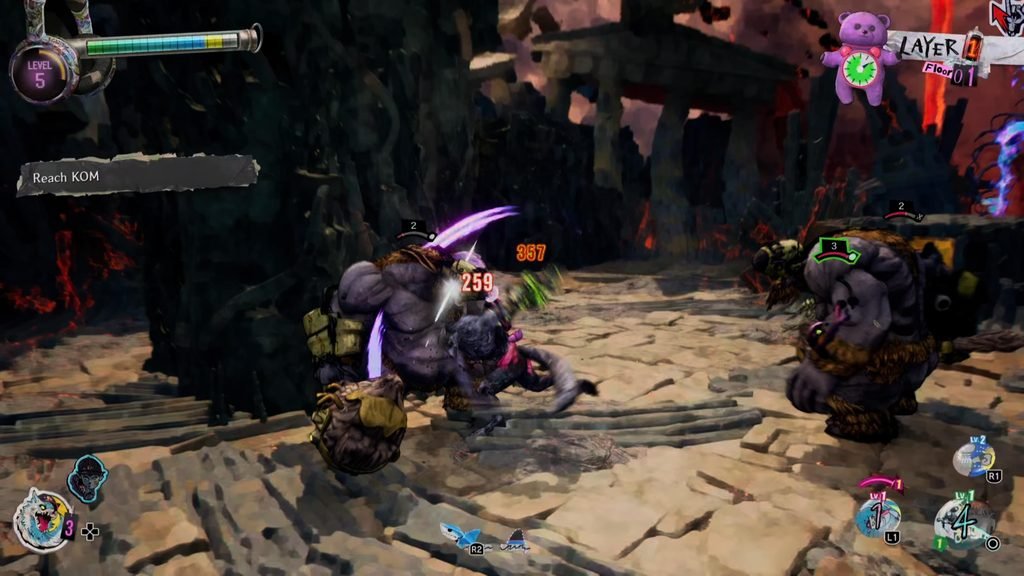
The gameplay matches the chaotic energy of the story, characters and presentation. Combat is fast, frantic, and ground-or-air capable, sitting comfortably in a middle ground between a 3D brawler like Yakuza (pre-Like a Dragon) and a stylish action title like Devil May Cry. It doesn’t quite reach the technical complexity of DMC, but it provides an engaging, visually satisfying loop.
The core gimmick revolves around the “Style Bite” mechanic. By damaging enemies and exposing their cores, Davy can bite them to heal, steal their abilities, and absorb their fighting style—effectively transforming into that enemy for a set number of dungeon floors (usually 2 or 3). In this demo, I encountered three distinct transformable enemy types: Werewolves, Harpies, and Liches.
Davy’s standard attacks feature wild, flailing animations that emphasize his complete lack of formal combat training. However, these animations transform entirely depending on your active form:
- Werewolf Form: My personal favorite. Offers close-range brawling, cool wolfish animations, and specialized movement options like wall-bouncing.
- Harpy Form: Unlocks evasive airborne maneuvers and dedicated dodge mechanics.
- Liche Form: Grants ranged spellcasting and elemental projectile attacks.
Boss Encounters & Skill Checks
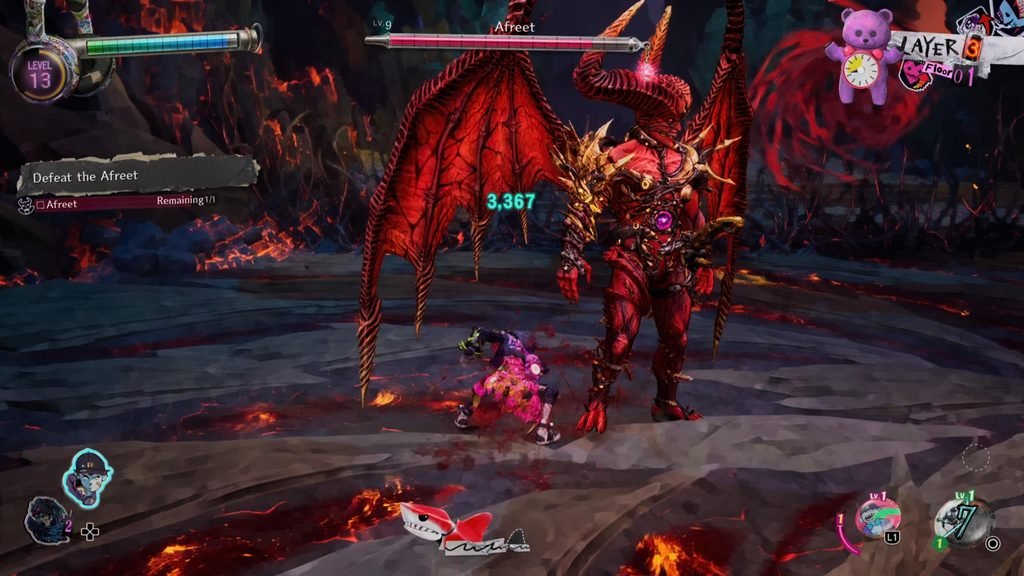
The game truly hit its stride during the first Layer Boss fight against Afreet. This was the moment where the mechanics clicked into place and I finally mastered the “Style Parry”—a timing window that functions simultaneously as a dodge and a deflect. Chaining basic attacks, OT Gear abilities, and well-timed Style Bites to heal mid-combo allowed me to beat Afreet on my first try.
However, I vastly underestimated the demo’s challenge until meeting the second Layer Boss, The Phoenix. The Phoenix soundly kicked my ass three or four times before I realised a purely aggressive brawling strategy wouldn’t work. To beat it, I had to utilize Davy’s evasive Harpy movement and ranged abilities, weaving in and out of strike zones while timing my bites to sustain Davy’s health bar.
A Missed Opportunity for Traversal
Where the game drops the ball slightly is between combat arenas. As a big fan of 3D platformers, I lamented the lack of platforming mechanics during exploration. Outside of the Werewolf’s context-specific wall-bounce, there is virtually no traversal gameplay, despite Davy having a dedicated jump button. Given the wacky aesthetic, adding light platforming to environmental navigation would have complemented the combat loops significantly better than running down empty hallways.
Exploration & Progression: Deep Build Customisation
Once you get past the tutorial hurdle, the progression loop is addictive and surprisingly deep. Dungeons are split floor-by-floor into “Layers.” During repeated “dives,” Davy gains temporary power-ups, levels up his affinity with specific Styles, and collects resources. Upon death, temporary levels and parts are lost, but permanent progress is retained.
Between runs, you return to The Mall on the “Human Level,” which acts as your hub. Because Davy is a slow, clumsy zombie when not in KOM’s domain, he navigates the mall by riding on top of a robot vacuum cleaner—a perfect summary of the game’s commitment to absurd details. Here, you talk to friendly NPCs, progress story beats, and upgrade Davy’s stats.
Build customization is driven by the Body Hack and OT Gear (Over Tech Gear) systems. Equipping OT Gear permanently increases Davy’s base stats and unlocks active or passive abilities—ranging from defensive Barrier Shields to offensive Missile Launchers—which can be synergized with your active Style Bites.
The “Egregious Signposting”
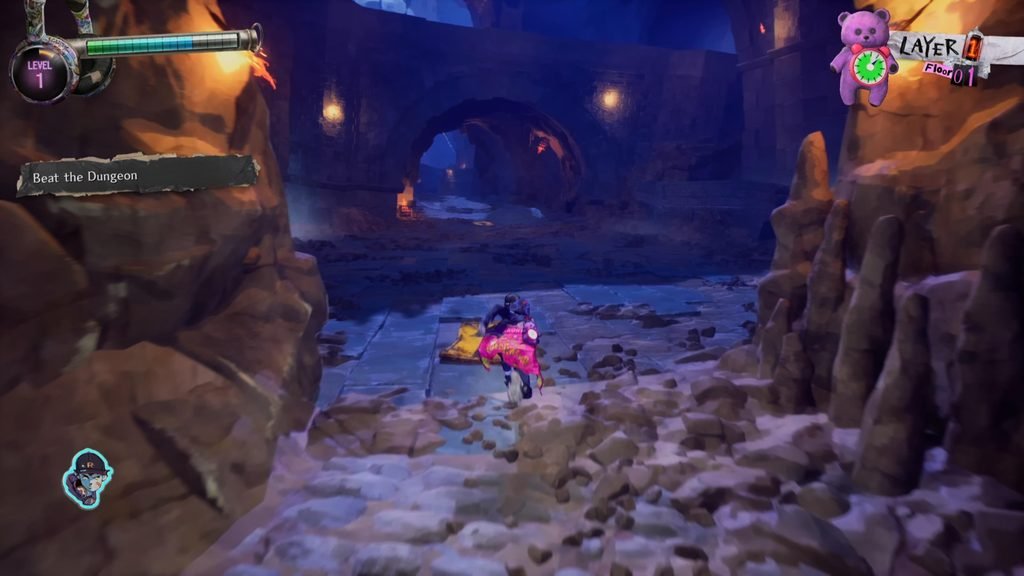
Level design in the demo is quite linear, consisting primarily of flat corridors leading into combat arenas. Interestingly, these corridors are filled with bright yellow arrows and signposts pointing straight forward. While this initially seemed comically redundant in a unbranched hallway, it makes sense in context: after chaotic combat encounters, it is easy to lose your orientation. Because each floor is timed (and time spent impacts your final score multiplier), the signposts prevent players from accidentally backtracking and wasting precious seconds.
Visuals & Sound: A Neo-Pop-Punk Masterclass
Visually, Stupid Never Dies is crisp and vibrant. While the dungeon environments themselves (lava zones, chained stone corridors) are fairly generic, the cel-shaded character models and visual effects give it a distinct visual punch.
However, the sound design is the true unsung hero of this demo. Developers Studio Sai took the unique approach of creating the soundtrack first during pre-production, using the music to guide the game’s narrative tone and gameplay feel.
Drawing from heavy metal, rock, electronic, and traditional Japanese instrumentation, the OST maintains a roaring “Neo-Pop-Punk” vibe that captures raw, frantic energy. It shifts dynamically between high-stakes boss encounters and the laid-back exploration tracks played inside The Mall.
The audio feedback in combat is equally bespoke:
- Impact FX: Features wet, heavy tearing and flesh-rendering sounds when Davy attacks.
- The Style Parry: Instead of a clean, metallic cling (like Sekiro), the parry audio cue is a thick, squishy impact that sounds like a zombie body physically absorbing a blow.
- The Style Bite: Accompanied by an exaggerated, cartoonish chomp followed by an arcade-style gulp.
Every layer of audio design feels deliberate, giving the combat an immensely satisfying tactile weight.
Final Thoughts: Rough Edges, Huge Potential
I thoroughly enjoyed my time with the Stupid Never Dies demo. My critiques stem from a place of genuine appreciation rather than dissatisfaction; taking over two hours to complete, this demo proved to be a surprisingly substantial slice of gameplay.
You can instantly tell this is a passion project built by a team that deeply values personality, creative sound design, and player agency. I found myself fully invested in Davy’s quest to save Julia, as well as the mechanical rhythm of its combat loop.
Stupid Never Dies delivers solid rogue-lite mechanics, a distinct visual identity, and rewarding build customization. This demo left me hungry for the full release—be sure to check back for my complete review right here on Life is a Game Magazine!

Leave a Reply