Chainstaff Review
Heavy Metal, Bug Heads, and a Whole Lot of Heart
REVIEWS
Woody Wood
4/21/20265 min read
You know a game has you hooked when you pause mid-level just to play air guitar to the soundtrack. That was my experience with Chainstaff. I found myself vibing to crunchy, 80s-style metal riffs, the outlandish alien monstrosities coming at me, and the unique art style.
The gang at Momma’s Best Games have been making odd-looking retro 2D action adventure games for quite some time now, and they’ve nailed it with Chainstaff.
It drops you on a version of Earth that’s being overtaken by an alien infestation known as the Encroachment. You play as Jessie, a marine whose squad gets wiped out while fighting the invasion. He survives after a parasite latches on to his head, giving him a set of very questionable “upgrades” his military leaders are keen to turn on the enemy.
It’s an insane premise fueled by an equally cheesy string of dialogue that underscores the game’s absurdity – you’re a guy with a bug for a head fighting off creatures from your worst acid trip with a bone spear.
Chainstaff isn’t perfect. The combat can feel uneven, the structure is pretty linear, and I struggled with the controls at times. But what it lacks in polish, it more than makes up for in creativity, presentation, and sheer value.
A Cool Twist on An Old Formula
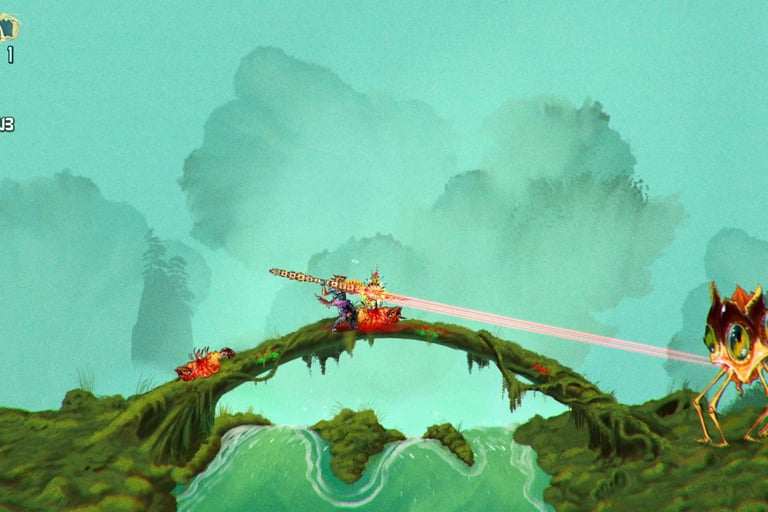
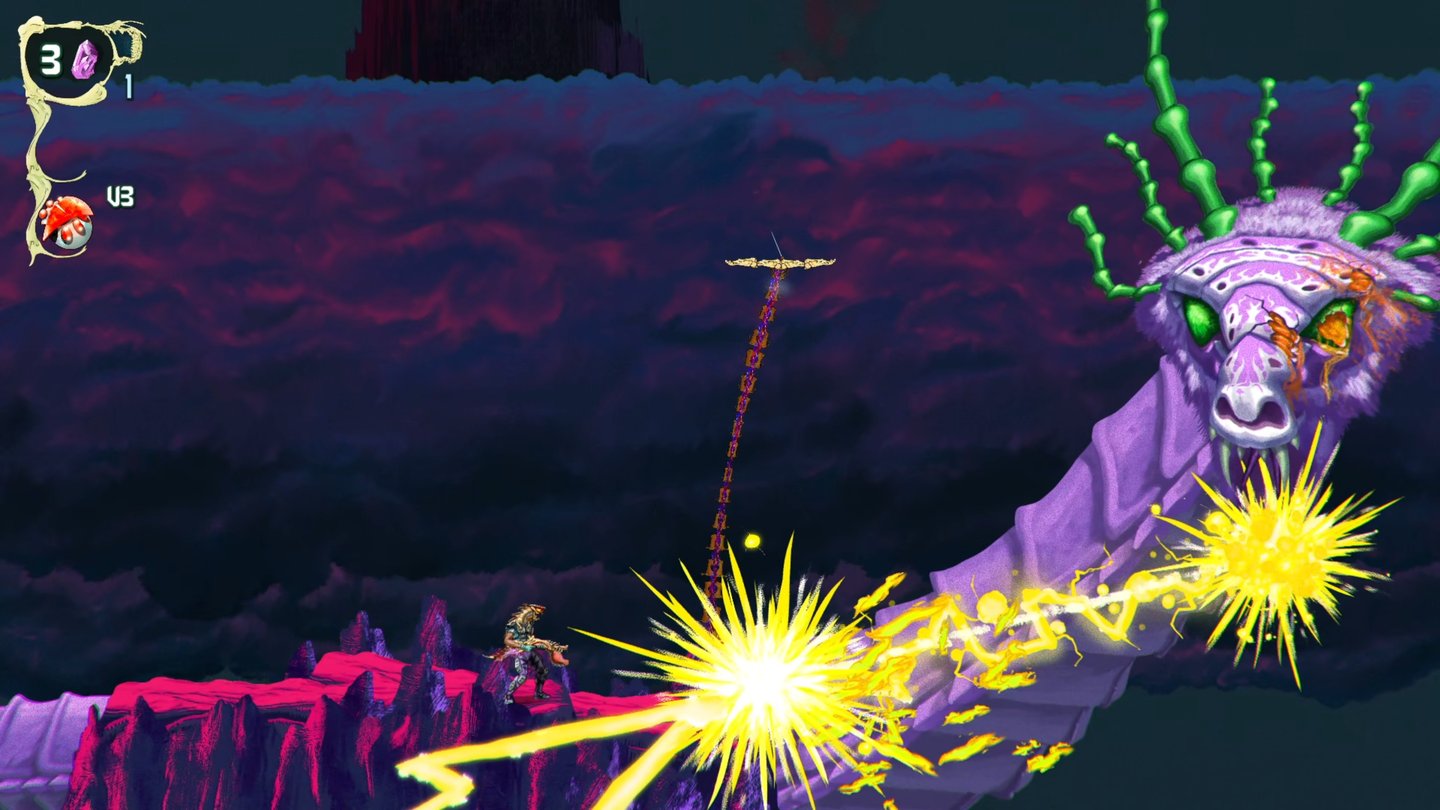
The core of Chainstaff revolves around, unsurprisingly, the Chainstaff itself. It’s a spear that doubles as a grappling tool, and almost everything you do in the game flows through it. You’ll use it to swing across gaps, lift heavy objects, latch onto surfaces, block incoming fire, and crack open tougher enemies that your gun can’t deal with.
It’s a really clever system that changes how you move and interact with the world in a way that I haven’t seen very often in 2D platformers.
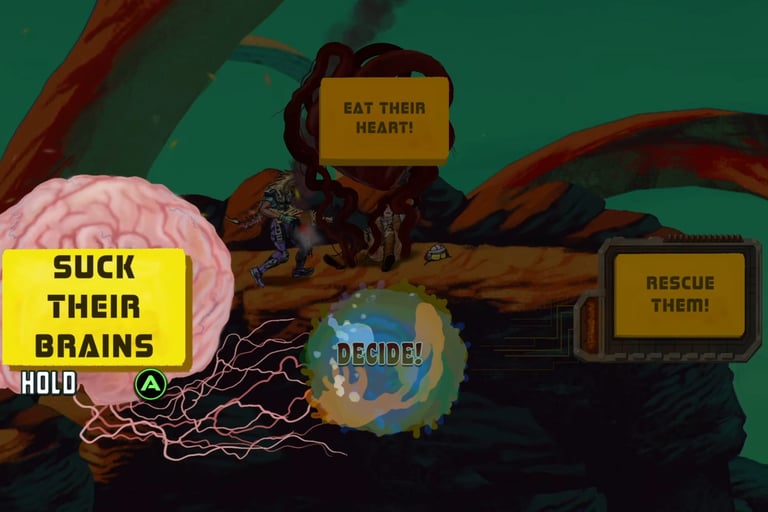
Chainstaff also introduces a unique upgrade system that revolves around finding stranded crew members. Rescuing them rewards you with tech points you can use to upgrade your shield or one of your four secondary weapons.
However, you also have the option to cannibalize your former colleagues by harvesting their heart or their brain to get a temporary boost in health or damage output. Doing it multiple times impacts which of the game’s 3 endings you get.
Between that, the Chainstaff upgrades, and the parasites that grant you new abilities, there’s a good amount of depth to progression that makes it feel like you’re constantly improving.
Where things start to wobble a bit is in the combat itself.
I found myself dealing with most encounters by standing still and shooting enemies from far away. Then,the game would suddenly shift gears and throw a swarm of enemies and projectiles at me all at once.
It created an uneven rhythm where I was either barely being challenged or frantically fighting for my life. Those more demanding sections hit hard because Jessie can only take a few hits, can’t heal, and has to make his way back from the last beacon when he dies.
Manually controlling the staff to move around the screen didn’t feel as intuitive as it should, either. I often sent myself crashing into enemies or got stuck around corners.
That said, the fun here doesn’t really come from tight, fast-paced combat. It comes from seeing what the game throws at you next.
Pure Creative Chaos
This is where Chainstaff really shines.
In keeping with retro games, the level design is incredibly linear, but MBG added a lot of vertical space using all kinds of objects to grapple with the Chainstaff. You’ll also encounter branching paths in each level that lead to a boss or other key items like Psychic Embryos or Star Spores.
The end result is that levels feel bigger than they actually are, and you have a reason to play them multiple times.
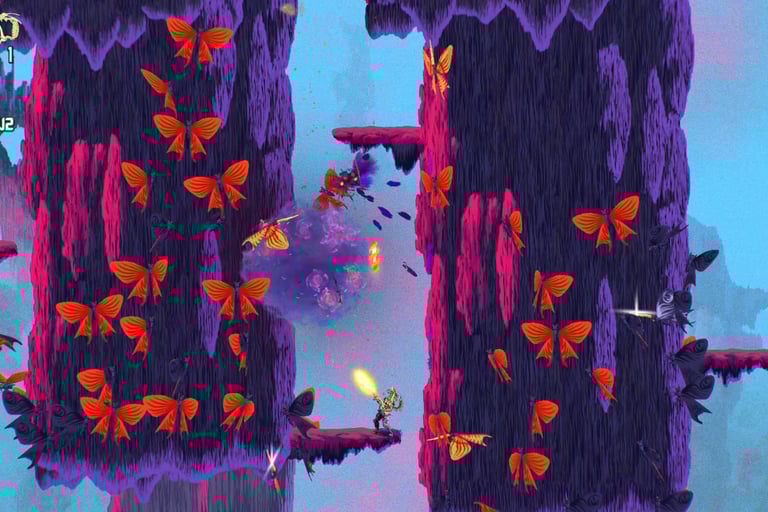
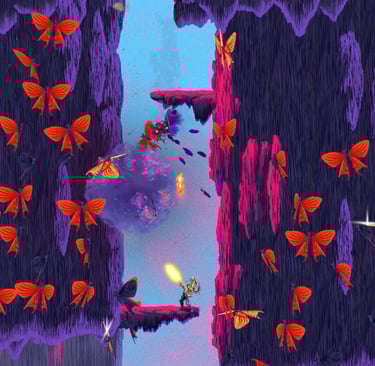
Each one introduces some new mutation or visual idea that makes you stop for a second and stare. For example, one level starts you in an area covered wall to wall with butterflies that look like decorations…until they swarm you as you get close.
You’ll fight things like squirrels that shoot spikes from their tails, giant lanternfish, a worm with an eagle’s head, and a slew of other creatures straight out of an 80s sci-fi fever dream.
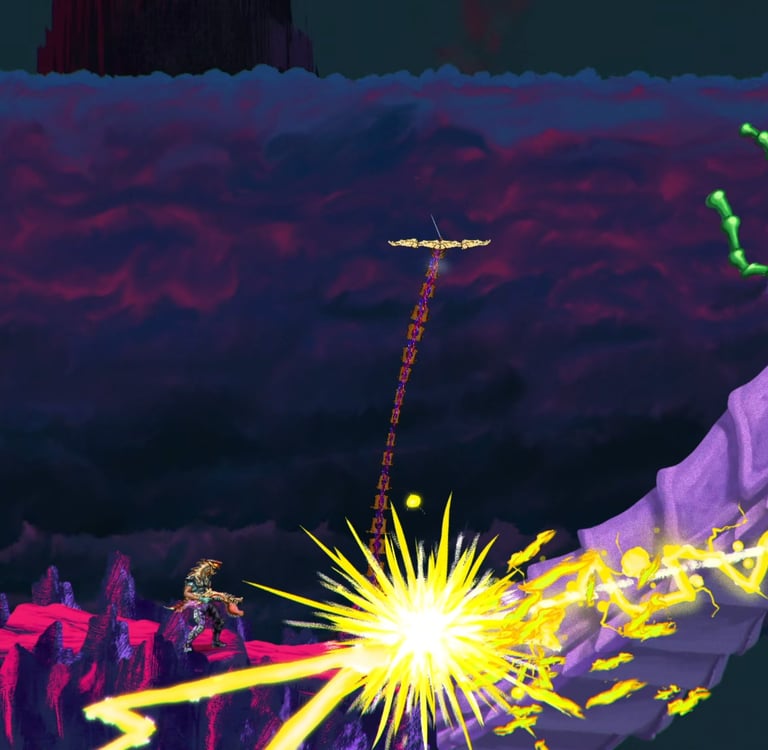
The boss encounters are even more creatively weird. They’re not as challenging as other games that have you memorizing complicated attack patterns. Instead, the challenge comes from figuring out how to actually damage them in the first place – and that usually involves the Chainstaff.
One fight has you grappling a massive cell-like organism to pull out its guts so you can shoot them. Another has you cracking open a crocodile’s jaw so you can push out and destroy its brain. The game doesn’t spell out the solution, leaving it up to you to experiment until you find it.
That constant discovery of strange things to fight is what makes Chainstaff exciting to play. This game is about unbounded imagination and creativity.
A Textbook Budget Win
It just so happens to be very budget-friendly as well. I paid about $15 CDN for it, and it took me roughly 10 hours to finish my first run. You could probably get through it in 6 to 8 if you rush, but that would defeat the purpose of playing a game like this for the first time.
Chainstaff has a decent amount of replayability built in. Beating the game opens a New Game+ option that lets you keep your upgrade points. That lets you collect the remaining power-ups and make different choices about the stranded soldiers.
If you’re aiming to see everything, including the different endings, you’re probably looking at closer to 15-20 hours. Games like this one also lend themselves well to community challenges like hitless boss fights and speedruns, which could help stretch your playtime even further.
The only real downside is that there doesn’t seem to be a higher difficulty setting. So while replaying the game lets you explore different options, the experience will be pretty much the same.
Still, it’s hard to argue with the price tag. This is the kind of game you keep in your library just to show people something they’ve probably never seen before.
It also helps that this game can easily run on the last generation of PC hardware. You don’t need to worry about upscaling or acceleration. You just install it and play.
This is a great example of what budget games can be when an experienced studio focuses on originality instead of scale.
Final Verdict
Chainstaff is about the experience of moving through a heavy metal fan’s fantasy made into a B-rated sci-fi movie.
What you’ll remember are the moments like the first time a twisted enemy reveals itself, when you first figure out how to expose a boss’ weakness, or the crazy platforming section that had you swinging from a monster’s tongue.
Side-scroller purists might take issue with some of the game’s rough edges, but for an initial price of $15, it’s hard to walk away from Chainstaff feeling like you didn’t get your money’s worth.